

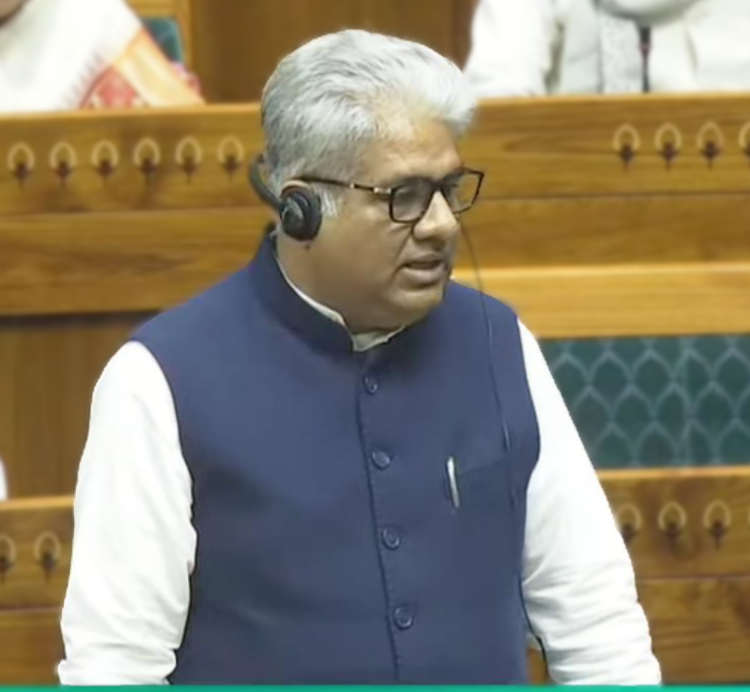

New Delhi, December 1: Union Environment and Climate Minister Bhupender Yadav told the Lok Sabha that the biggest reason for pollution in Delhi-NCR is not stubble burning in Punjab and Haryana, but local sources like vehicular smoke, industrial pollution, dust from construction and demolition activities and biomass.
He said that incidents of stubble burning have reduced by about 90 percent in Punjab and Haryana in 2025 as compared to 2022 and with this, Delhi’s air quality has also improved significantly.
Bhupender Yadav, in response to a written question asked in the Lok Sabha, said that the days with AQI less than 200 in Delhi have increased from 110 in 2016 to 200 in 2025. Meanwhile, the number of days in the very poor and severe categories has decreased from 71 in 2024 to 50 in 2025. While stubble burning contributes to winter pollution, it is not the primary cause, and the bulk of the pollution comes from sources within the Delhi-NCR region.
He stated that the government has provided a total of ₹3,120 crore in assistance to Punjab and Haryana from 2018-19 to 2025-26 for stubble management. Over 260,000 CRM machines have been provided to farmers and CHCs in both states. Instructions have also been issued to plan for free access to machines for small farmers and to mandate the use of biomass pellets and briquettes made from paddy straw in brick kilns and thermal power plants. Thermal power plants in the NCR and surrounding areas will be required to combine at least 5 to 10 percent biomass with coal.
Bhupender Yadav’s response stated that 31 CPCB flying squad teams have been deployed in hotspot districts of Punjab and Haryana to control stubble burning, monitoring and reporting daily. The central government has also held several high-level meetings on this issue, involving senior state officials and district administrations, and directed them to effectively utilize machines and tighten monitoring.
The response stated that while there were 1,547 stubble burning incidents in Punjab in October, the number jumped to 3,470 in the first 29 days of November, representing a 124 percent increase compared to October. In Ferozepur, 381 cases were reported in November compared to 166 in October. Sangrur reported 279 to 414 cases, Tarn Taran 363 to 322, Bathinda 91 to 277, Mansa 41 to 265, Sri Muktsar Sahib 33 to 343, and Moga 32 to 300. The lowest number of cases were reported in Pathankot, Mohali, SBS Nagar, and Hoshiarpur.