

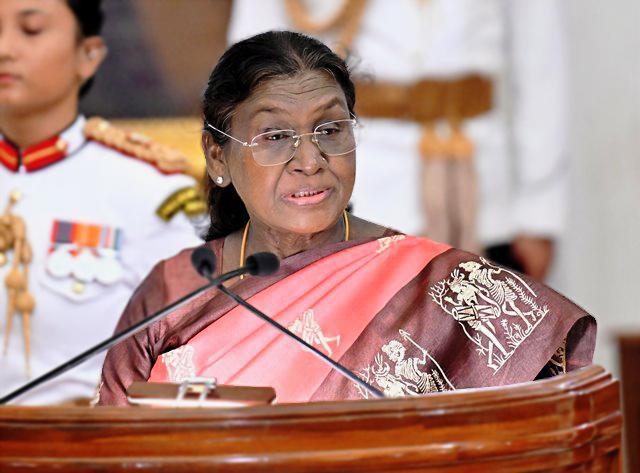

New Delhi, December 21: President Droupadi Murmu has approved the ‘Viksit Bharat – Guarantee for Rozgar and Aajeevika Mission (Gramin) Bill, 2025’ (VB-G Ram G). With the President’s approval, the bill became law.
Both houses of Parliament had previously passed this bill. Now, a major change in the rural employment system has been implemented. Under the new law, rural families will be guaranteed 125 days of statutory wage employment per financial year, up from the previous 100 days.
According to the Union Rural Development Ministry, this act replaces the Mahatma Gandhi National Rural Employment Guarantee Act, 2005, and has been prepared in line with the vision of Developed India 2047. The government aims to strengthen income security in rural areas and build durable and productive assets to promote inclusive and balanced development.
Under the provisions of the law, the government will be statutoryly responsible for providing a minimum of 125 days of employment to willing rural households. Payment of wages is mandated on a weekly basis or within a maximum of 15 days. There is also a provision for compensation for delays in payment of wages within the stipulated timeframe.
To maintain the availability of workers during agricultural operations, states have been authorized to declare a consolidated break period of up to 60 days in a financial year. However, this will not affect the right to a total of 125 days of employment, and full employment will be provided during the remaining period.
Under this law, all work plans will be prepared by Gram Panchayats with the approval of the Gram Sabha. The planning process will be completely bottom-up, while digital platforms will be used to coordinate various schemes and departments at the national level. The government believes this will prevent wastage of resources and accelerate development work.
Employment has also been linked to water conservation, rural infrastructure, livelihood-related structures, and works to address natural disasters and climate impacts. Assets created through these works will be included in the Develop India National Rural Infrastructure Stack.
The ministry stated that the scheme is centrally sponsored. For general states, the cost sharing between the center and the state will be 60:40, while for northeastern and Himalayan states, the provision has been made 90:10. In union territories without legislative assemblies, the central government will bear the entire expenditure. The administrative expenditure limit has also been increased from 6 percent to 9 percent.