

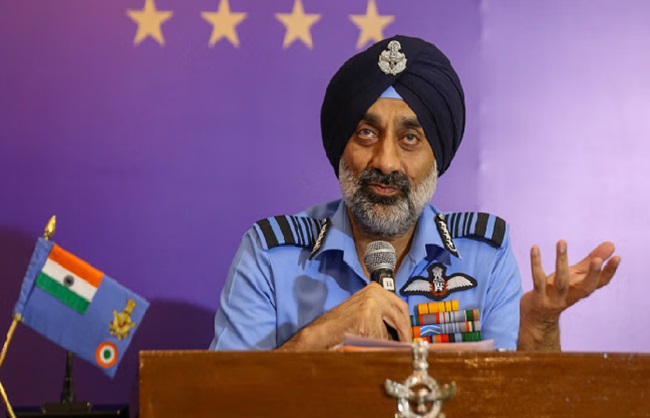

Bengaluru, August 09: The Indian Air Force (IAF) Chief Air Chief Marshal A P Singh made a big revelation on Saturday about “Operation Sindoor” that the IAF shot down five Pakistani fighter planes by attacking from a distance of 300 kilometers. The Indian Air Force weakened Pakistan’s air power by attacking Jacobabad and Bholari air bases. This was the biggest surface-to-air attack by India so far.
Air Chief Marshal A P Singh, while discussing the results of Operation ‘Sindoor’ during a program here, said that we have confirmed the downing of at least five Pakistani fighter planes. We managed to destroy at least two command and control centers like Murid and Chaklala. At least six radars were destroyed here, some of which are big and some are small. Apart from this, an Airborne Early Warning and Control (AWACS) or Electronic Intelligence (ELINT) was shot down by India from within its own border from a distance of 300 km. Pakistan’s Jacobabad airport is one of the major airports that were attacked. There is also a hangar of F-16 Fighting Falcon multi-purpose fighter aircraft of the Pakistani Air Force, half of which was destroyed and some aircraft inside have been confirmed to be damaged.
The Air Force Chief said that this was indeed the biggest surface-to-air attack ever by India during Operation ‘Sindoor’, about which we can now talk openly.
Showing the before and after pictures of the attack on the Lashkar headquarters in Muridke during Operation Sindoor, Air Chief Marshal AP Singh said that this is the residential area of their senior military leadership. This was their office building, where they used to gather to hold meetings. Showing the before and after pictures of the attack on the Jaish headquarters in Bahawalpur, the Air Force Chief said that there is almost no remains left here in our attack, while the surrounding buildings are almost completely safe. Before the attack, we not only had satellite images, but also pictures from the local media, through which we could get pictures inside.
The Air Force Chief said that no Pakistani aircraft could come close to the range of our Akash missile defense system and even the medium range surface-to-air missile system. All their aircraft were targeted by our long-range surface-to-air missiles because they were trying to stay away, but still they were in our range many times and that was the opportunity for us. As far as our attack is concerned, we had no restrictions that night and we decided that we would attack pan front, we would use our resources. Once again our objective was not to attack and destroy any particular airfield, but to make them realize that look, we can attack you deep inside, as per our wish, wherever we want.
Air Chief Marshal AP Singh said that our air defense systems have done a great job during the operation. The S-400 system has been a game-changer, which we recently bought from Russia. Its range has really kept Pakistan’s weapons away from our weapons, such as the long-range glide bombs they have, but they have not been able to use any of them, because they were not able to penetrate our system.
Chief Marshal AP Singh said about Sargodha Airbase that we have grown up dreaming of such days in our Air Force that someday we will get a chance to go there. Coincidentally, I got this opportunity just before retiring, so we fulfilled my dream by attacking the airport there.
Recalling the Balakot air strike, he said that in Balakot we could not achieve anything from inside, so unfortunately it became difficult to tell our own people what we had achieved. We had intelligence of what had happened inside, we had human intelligence, which gave us a very clear picture inside that how big the damage was. A lot of terrorists have been killed, but we could not convince our people about what we have achieved. We are very happy about the achievements of Operation ‘Sindoor’ because this time we were able to deal with the ghost of Balakot and tell the world what our strength is and what we have achieved.
Air Force Chief Air Chief Marshal AP Singh supported the decision to stop Operation ‘Sindoor’ and said that it was a high-tech war. In 80 to 90 hours of war, we were able to cause so much damage that they clearly realized that if they continue it, they will have to pay an even bigger price for it. So they came forward and sent a message to our DGMO that they want to talk. It was accepted from our side.
He said that the main reason behind our success was political will.
He said that we were given very clear instructions before the operation. No restrictions were imposed on us, if there were any obstacles, they were self-made, so we decided how far to go, we had complete freedom to plan and execute it. Our attacks were well thought out, because we wanted to be mature about it. There was coordination between the three forces, because the post of Chief of Defense Staff (CDS) really made a difference. He was there to bring us together. The National Security Advisor also played a big role in bringing all the agencies together.