


Lucknow, January 30: Chief Minister Yogi Adityanath has emphasized making the financial approval process for projects in the state faster, simpler, and transparent.
He also emphasized increasing the fiscal autonomy of ministers to expedite project implementation. He talked about giving the minister level the authority to approve projects up to 50 crore rupees, and the Finance Minister up to 150 crore rupees.
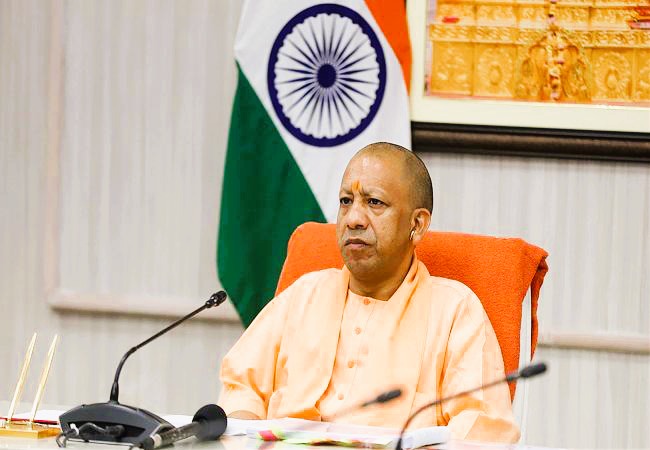
Chief Minister Yogi Adityanath was conducting a detailed review of the Finance Department at his official residence on Friday.
He discussed the state’s fiscal situation, budget management, capital expenditure, construction arrangements, lump-sum provisions, digital financial reforms, treasury procedures, pension systems, and departmental innovations.
In the review meeting, he stated that the approval limit for departmental projects, currently at the ministerial level of ₹10 crore, should be increased to ₹50 crore. Subsequently, projects costing ₹50 to ₹150 crore should be approved at the Finance Minister’s level, and projects costing more than ₹150 crore should be approved at the Chief Minister’s level, ensuring timely financial approval and faster progress.
The Chief Minister directed all departments to have their annual action plans approved by April 15th. A list of departments failing to meet the deadline will be sent to the Chief Minister’s Office. He also clarified that if a project’s cost increases by more than 15%, the department must seek re-approval with reasons.
The Chief Minister stated that Uttar Pradesh should be transformed into a model state of robust, transparent, and result-oriented financial management. To achieve this, all departments should prioritize timeliness, quality, transparency, and digital processes. He directed that a State Guarantee Policy be implemented in Uttar Pradesh, modeled after the Central Government.
The Chief Minister directed that it be ensured that the honorarium of low-paid workers, such as Asha workers and Anganwadi workers, reaches their bank accounts on the due date each month. In schemes where the central government provides funding, the state should release the honorarium from its own funds on time, so that no worker faces any delays. This system should be implemented as soon as possible.
The meeting was informed that Uttar Pradesh’s capital expenditure of ₹1,10,555 crore in 2023-24 was the highest in the country. The state spent more on capital works than its net public debt, a strong indicator of fiscal discipline. By devoting 9.39% of total expenditure to investments, Uttar Pradesh ranked first in the country. All indicators, including fiscal deficit, revenue deficit, and debt/GSDP ratio, remained in line with FRBM standards. The state’s total liabilities declined to 27% of GSDP in 2024-25. According to NITI Aayog, Uttar Pradesh’s composite fiscal health index has increased from 37 in 2014 to 45.9 in 2023, placing the state in the front-runner category.
The Chief Minister was informed that the RBI report also ranks the state’s own tax revenue second in the country, with a national share of 11.6%. Development expenditure (as a percentage of GSDP) has consistently exceeded the national average, and Uttar Pradesh also ranks among the top states in health expenditure.
Over the past three years, the Finance Department has implemented several reforms in budgeting, treasury, and digital financial administration, including the introduction of an online budget module, a vendor management system, a cyber treasury, fully online bill remittances, prevention of GPF irregularities, online submission of salary bills to the AG, and availability of GPF slips on DigiLocker. As part of these treasury reforms, completely paperless remittance of accounts through the cyber treasury will be completed by April 2026.
Regarding innovations by the Firms, Societies, and Chits Department, it was reported that the department has digitized all its key services. Old records are being digitized. The ‘Sadar’ portal has provided easy access to records to the public. A litigation management system has been developed, and Uttar Pradesh has become the first state to integrate with NITI Aayog’s ‘Darpan’ portal.
Regarding the maintenance system for government buildings, the Chief Minister stated that there is a lack of uniformity in contracts. Following the example of road construction, all new buildings should be mandated to include a five-year payment-based maintenance. He emphasized the need to establish a corpus fund for the maintenance of older buildings.
To ensure construction quality, the Chief Minister directed that third-party quality audits of projects such as buildings, roads, bridges, sewer lines, and water supply pipelines be conducted by IITs, NITs, and state/government technical institutions.
The Chief Minister stated that Uttar Pradesh has set new standards in the country in financial discipline, capital expenditure, and revenue enhancement. The goal now is to further strengthen spending quality and digital transparency, making the state one of India’s most efficient and reliable financial administrations.