

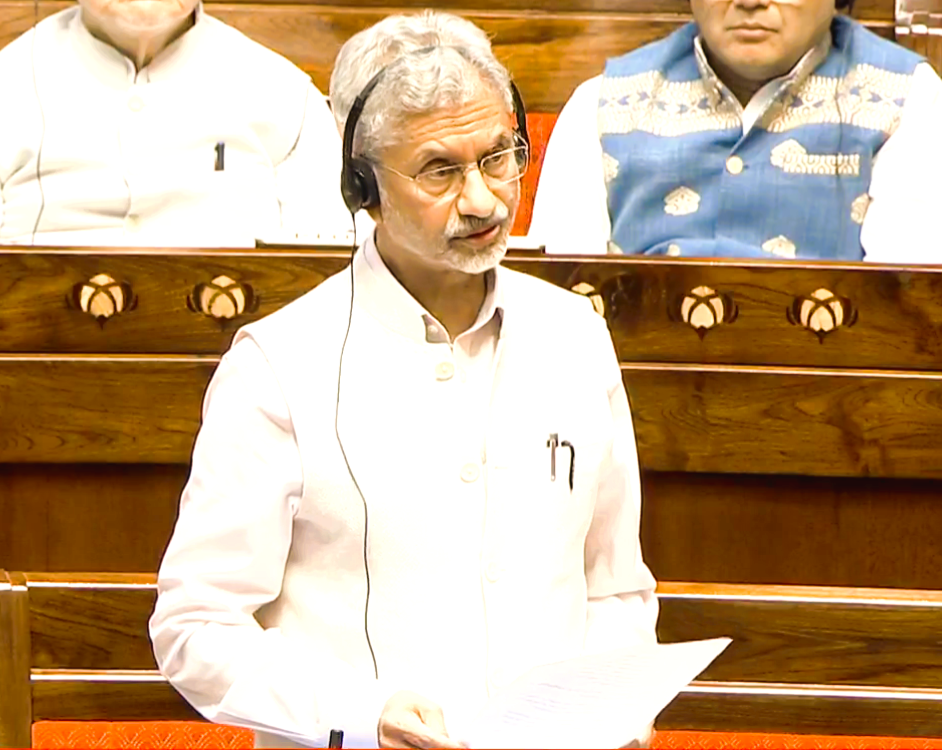

New Delhi, March 9: The External Affairs Minister (EAM) S. Jaishankar said in Parliament on Monday that the Indian government is closely monitoring the ongoing conflict in West Asia and is taking all possible steps to ensure the safety of Indian citizens present in the region.
In his statement on the ‘Situation in West Asia’ in the Lok Sabha and Rajya Sabha, Jaishankar said that the conflict, which began on February 28, pits Israel and the US on one side and Iran on the other, while several Gulf countries have also been attacked. This conflict has caused heavy casualties and damage to infrastructure.
He said that in view of the gravity of the situation, a meeting of the Union Cabinet’s Security Committee, chaired by Prime Minister Narendra Modi, was held on March 1, in which the safety of Indians living in the region and the impact on regional security, trade, and economic activities were reviewed. The Committee was informed of the difficulties faced by Indian travelers traveling to and from the region and students appearing for examinations in these countries. It directed all relevant ministries and departments to take appropriate steps to address these issues. The Prime Minister is closely monitoring the new developments.
The External Affairs Minister stated that West Asia holds special significance for India, as approximately 10 million Indian citizens live and work in the Gulf countries, while thousands of Indian students and professionals are also present in Iran. Furthermore, the region is crucial for India’s energy security. The Gulf countries are also a major trade partner, transacting approximately US$200 billion annually. The House is also aware that significant investment has flowed into the Indian economy from this region over the past decade. Therefore, we consider serious disruptions to supply chains and the resulting instability as serious issues. Furthermore, these include attacks on merchant shipping, where Indian nationals often constitute a large part of the crew. Sadly, we have already lost two Indian sailors in such incidents, and one is still missing.
He stated that the government had issued travel advisories for Iran since January, sensing worsening conditions, and advised Indian citizens to avoid unnecessary travel. Indians were also urged to leave Iran by all available means on February 14th and 23rd.
Since the conflict began, the Indian Embassy has assisted Indian students living in Tehran in evacuating them to safety and has also assisted some Indians who were there for business purposes in returning to India via Armenia.
He added that Indian travelers stranded in transit centers like Dubai, Doha, and Abu Dhabi have also been assisted, and arrangements have been made for their safe evacuation through the borders of several countries. To date, approximately 67,000 Indian citizens have returned on various flights.
Jaishankar stated that, at Iran’s request, one of its vessels, the Iris Lavan, was allowed to dock in Kochi on March 4. The ship’s crew is being housed at Indian naval facilities, and Iran has expressed gratitude to India for this humanitarian assistance.
He stated that the government is paying special attention to this issue, given the potential impact of this conflict on India’s energy security. The government is committed to ensuring supplies while fully considering the responsiveness, costs, and risks of the energy market. The interests of Indian consumers have always been and will continue to be a top priority. When necessary, Indian diplomacy has also supported the efforts of the country’s energy companies in this volatile situation.
The Foreign Minister stated that the government’s policy is based on three key principles: supporting peace and a diplomatic solution in the region, giving top priority to the safety of the Indian community living in West Asia, and protecting India’s national interests, especially energy security and trade flows.
He stated that India appeals to all parties to exercise restraint and de-escalate tensions through dialogue.