

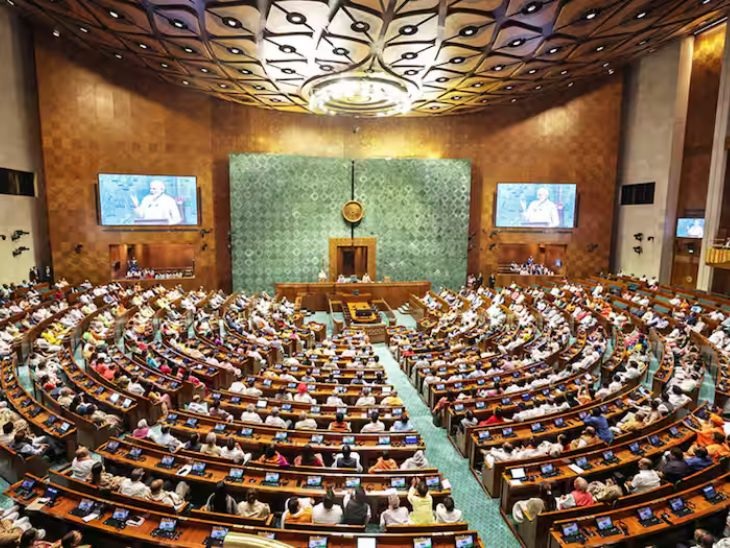

New Delhi, December 18: The Parliament has approved the Sustainable Harnessing and Augmentation of Nuclear Energy Bill, 2025, or SHANTI Bill for India’s Transformation.
Following the Lok Sabha , the Rajya Sabha also passed it by voice vote on Thursday after a marathon debate lasting over six hours. The bill had previously received Lok Sabha approval on Wednesday.
During the bill’s passage in the Rajya Sabha, opposition parties strongly protested and demanded it be referred to a standing committee. However, the government overruled the objections and approved the bill.
During the debate on the bill, the ruling party hailed it as crucial for the country’s energy security, clean energy goals, and future needs, while the opposition raised serious questions about safety, liability, privatization, and the regulatory framework.
Opposition members argued that such an important and sensitive issue required adequate time and thorough parliamentary scrutiny.
Introducing the bill, Dr. Jitendra Singh, Minister of State for the Department of Atomic Energy, stated that this law has been enacted keeping in mind changing times, technology, and global circumstances. He noted that the current situation is completely different from the one that faced opposition in 2010.
He said, “Technology is changing rapidly, and this change is dynamic. We are now in the era of small modular reactors, which are safer than before and have the capability to generate power even in densely populated areas.”
Dr Singh assured the House that the safety standards adopted under the Peace Bill are the same as those set out in the Atomic Energy Act of 1962. He categorically stated, “Safety in the field of nuclear energy will not be compromised at any cost.”
He also stated that the government is ready to discuss all suggestions and concerns. In his address, the Minister pointed out that nuclear energy is a 24×7 reliable source of power, while other renewable energy sources, such as solar and wind, face challenges of sustainability.
He stated that nuclear energy plays a crucial role in addressing climate change, energy security, and reducing dependence on fossil fuels.
Dr Singh also cited statistics to highlight the government’s achievements.
He explained that the Department of Atomic Energy’s budget, which was ₹13,879 crore before 2014, has increased to ₹37,483 crore in the current fiscal year. In 2015, the government permitted joint ventures in the nuclear sector, although at that time, this was limited to public sector undertakings only. In 2017, the Cabinet approved the simultaneous installation of 10 nuclear reactors, and in September 2025, the Prime Minister will lay the foundation stone for four new nuclear reactors.
He said that the country’s nuclear power capacity was 4.7 gigawatts in 2014, which has now increased to 8.9 gigawatts. However, this represents only three percent of total power generation. The government aims to increase this capacity to at least 10 percent by 2047. To this end, the Nuclear Energy Mission has been launched in this year’s budget, in which private sector participation will be a key component.
Supporting the bill, BJP MP Kiran Chaudhary said that the SHANTI Bill provides a modern and integrated framework by eliminating outdated and fragmented laws. She said that the bill consolidates provisions related to licensing, security clearance, liability, and compensation into a single law, eliminating policy confusion. She accused the opposition of spreading unnecessary fear about privatization.
During the discussion in the Rajya Sabha, nominated member Harsh Vardhan Shringla said that this bill is crucial for India’s energy future. According to him, this law aims to modernize the nuclear energy sector, encourage investment, and ensure national security and public safety.
Speaking on the opposition side, Congress MP Jairam Ramesh, highlighting India’s nuclear energy journey, said that the foundations of this sector were laid long before 2014. He cited examples such as the first nuclear law passed in 1948, the establishment of the Atomic Energy Commission, the three-stage nuclear program led by Dr Homi Bhabha, and the Apsara reactor.
Trinamool Congress MP Sagarika Ghosh described the SHANTI Bill as “the oligarchy of the Indian nuclear energy system.” DMK MP P. Wilson alleged that the bill weakens supplier responsibility and lacks clarity on critical issues such as nuclear waste management.
Aam Aadmi Party MP Sandeep Kumar Pathak said that India is adopting foreign private nuclear models but is not implementing a stringent regulatory framework like theirs. He demanded that regulatory bodies be accountable to Parliament and fully independent.
It is noteworthy that the passage of the Peace Bill, 2025, marks the beginning of a new chapter in India’s nuclear energy sector. Although the government has repeatedly assured that security, sovereignty, and public interest will not be compromised despite private participation, the opposition has indicated it will closely monitor its implementation.