

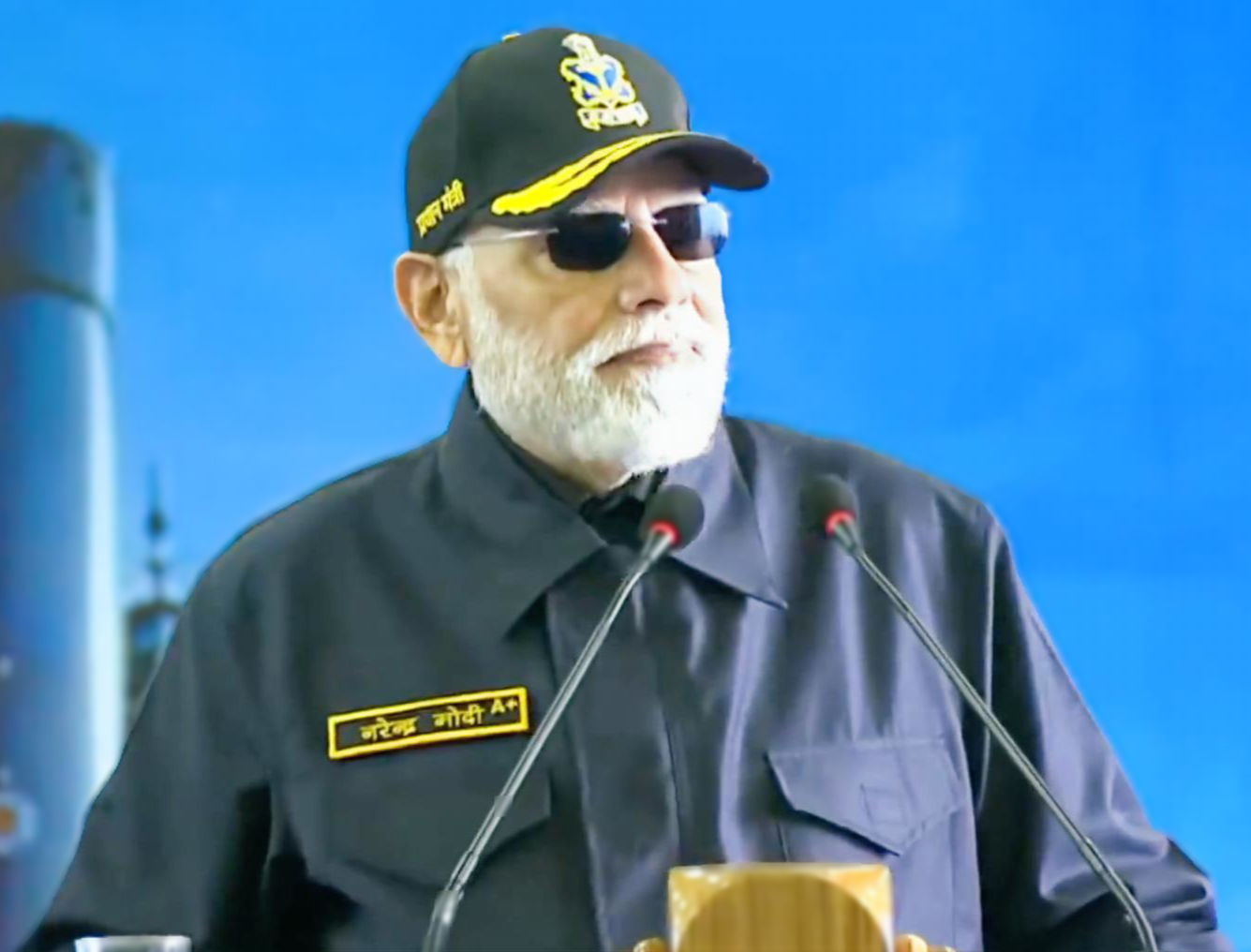

New Delhi, October 26: Prime Minister Narendra Modi highlighted the importance of Chhath Mahaparv in his monthly radio program “Mann Ki Baat” (MKB)on Sunday. He described it as a symbol of deep unity between culture, nature and society.
The Prime Minister said that every section of society stands together on the ‘Chhath ghats’, which presents a beautiful example of India’s social unity. He urged the countrymen to participate in this festival if they get the opportunity. This festival is not only a symbol of religious faith, but also a symbol of the unity and harmony of Indian society.
In the 127th episode of “Mann Ki Baat,” the Prime Minister covered topics such as festivals, culture, environmental protection, youth initiatives, promotion of indigenous breed dogs, the renaissance of Sanskrit, and the national anthem “Vande Mataram.” The Prime Minister extended his greetings on the occasion of Chhath Mahaparva, extending special greetings to the people of Bihar, Jharkhand, and Purvanchal, and urged the countrymen to participate in the festival.
Hyderabad’s Freedom Struggle and Komaram Bheem
Referring to Hyderabad’s freedom struggle, the Prime Minister spoke about Komaram Bheem, who raised his voice against the atrocities of the Nizam. His birth anniversary was celebrated on October 22nd.
He said that in the early 20th century, the struggle of patriots against the Nizam’s atrocities in Hyderabad was at its peak. The poor and tribal communities were being oppressed and heavily taxed. At that time, Komaram Bheem challenged an official named Siddiqui and fought against the Nizam’s atrocities for many years.
He explained that in those days, even speaking a word against the Nizam was considered a crime, the young man openly challenged an official of the Nizam named Siddiqui. The Nizam had sent Siddiqui to confiscate farmers’ crops, but in this struggle against oppression, the young man killed Siddiqui. He also managed to escape arrest, fleeing the Nizam’s brutal police force and traveling hundreds of kilometers to Assam. At the age of 40, Komaram Bheem left an indelible mark on many tribal communities. He posed a significant challenge to the Nizam’s authority. He was assassinated by the Nizam’s men in 1940.
Describing his life as inspirational, the Prime Minister urged young people to learn as much as possible about him.
Emphasis was placed on promoting indigenous dog breeds.
The Prime Minister today praised the adoption and training of Indian breed dogs in the security forces. He explained that five years ago, he had urged the countrymen and security forces to adopt Indian breed dogs. The BSF and CRPF have increased the number of Indian breed dogs in their contingents. The BSF’s National Training Centre is located in Tekanpur, Gwalior. Special attention is being given to the Rampur Hound, Mudhol Hound, and other Indian breeds. The training manual for these dogs has also been revised to highlight their special abilities.
The Prime Minister said, “Indian breed dogs adapt quickly to their environment and circumstances.”
He added that Indian breeds such as Mongrels, Mudhol Hounds, Kombai, and Pandikona are being trained at the CRPF’s Dog Breeding and Training School in Bengaluru. Last year, at the All India Police Duty Meet held in Lucknow, Mudhol Hound Riya won the first prize, beating out foreign breeds.
He explained that the BSF has now started the tradition of giving its dogs Indian names instead of foreign names. Our native dogs have also shown amazing courage. Last year, a native dog of CRPF had detected 8 kg of explosives while patrolling in the Maoist affected area of Chhattisgarh.
India’s National Anthem ‘Vande Mataram’
India’s national anthem ‘Vande Mataram’ is going to complete 150 years on 7th November. The Prime Minister sought suggestions from the countrymen on this subject. He said that this song composed by Bankim Chandra Chattopadhyay is a symbol of feeling and patriotism towards the motherland. Rabindranath Tagore sang it for the first time in 1896.
PM requested to send suggestions under #VandeMatram150 to make this occasion memorable.
He said, “‘Vande Mataram’ may have been written in the 19th century, but its spirit was connected to India’s thousands of years old eternal consciousness. The Vedas laid the foundation of Indian civilization by saying, “Mata Bhoomi: Putro Aham Prithviya:.” By writing ‘Vande Mataram,’ Bankim Chandra ji cemented that same relationship between the motherland and its children as a mantra in the world of emotions.”
Sardar Patel’s Birth Anniversary and Run for Unity
The Prime Minister said that Sardar Patel’s 150th birth anniversary will be celebrated on October 31st. The Prime Minister urged the countrymen to participate in the ‘Run for Unity’. Sardar Patel laid the foundation of modern India’s bureaucratic framework and made significant contributions to the country’s unity and integrity.
Sanskrit Renaissance and Youth Initiatives
The Prime Minister said that youth are active on social media platforms to revitalize the Sanskrit language. He said that language is the hallmark of any civilization and Sanskrit is regaining its popularity due to the efforts of the youth.
He also cited examples. Yash Salundke provides cricket commentary in Sanskrit, while Kamala and Janhavi present content on spirituality and music. The “Sanskrit Chhatraoham” channel promotes Sanskrit through teaching and humor. Bhavesh Bhimnathani shares shlokas and spiritual principles.
Ambikapur: Plastic Waste and Garbage Cafe Initiative
In Mann Ki Baat, the Prime Minister informed about a unique initiative regarding plastic waste in Ambikapur, Chhattisgarh. He explained that the Garbage Cafe, run by the Ambikapur Municipal Corporation, provides free food for those bringing plastic waste. Those bringing one kilogram of plastic receive lunch or dinner, and those bringing half a kilogram receive breakfast. This initiative has not only improved the city’s cleanliness but also increased environmental awareness. In the episode
“Bengaluru: Campaign for Lakes and Environmental Conservation,”
Prime Minister Modi praised engineer Kapil Sharma’s campaign to revive lakes and plant trees in Bengaluru, the capital of Karnataka. He explained that his team revived 40 wells and six lakes in Bengaluru and surrounding areas. Local people and corporates were involved in this mission. The Prime Minister described this as an inspiring example of change and environmental protection in the country.
Gujarat: Mangrove Plantation and Marine Life
Mangrove plantation work is progressing rapidly in Dholera and Kutch, Gujarat. This campaign, which began five years ago in Dholera, has now spread mangroves over 3,500 hectares. Speaking about this, the Prime Minister said that its direct impact is being seen on marine life, such as dolphins, crabs, and migratory birds. A Mangrove Learning Center has also been established in Kori Creek, Kutch.
He said, “This is the speciality of trees. No matter the location, they are useful for the well-being of every living being. Our scriptures say – Dhanya mahiruha yebhyo, nirashaam yanti naarthina. Meaning, blessed are those trees and plants that do not disappoint anyone. We too must plant trees, wherever we live. We must further the campaign of ‘One Tree for Mother’.”
Indian Coffee: Diversity
Citing the example of expanding coffee cultivation in Koraput, Odisha, the Prime Minister said that people have come into this field because of their passion for coffee and are achieving success. Coffee is cultivated in various states of India, such as Chikmagalur, Coorg, and Hassan in Karnataka; the Nilgiris and Annamalai in Tamil Nadu; and Travancore and Malabar in Kerala. Indian coffee is becoming famous globally.