

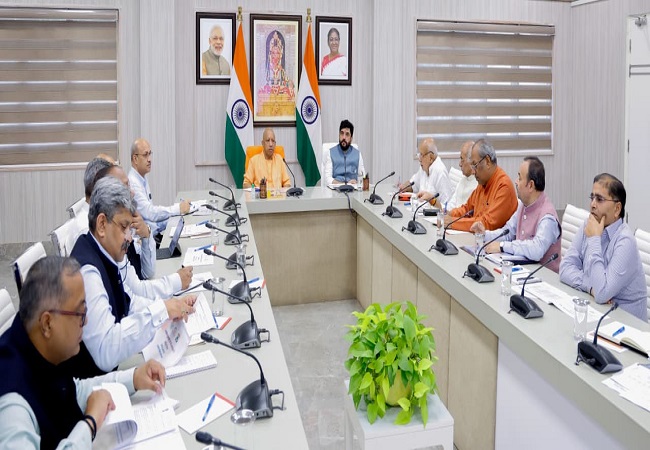

Lucknow, 16 September: Chief Minister Yogi Adityanath has decided to set up textile and apparel parks in various districts in view of the growing interest of private investors in the handloom and textile sector of the state.
In a high-level meeting on Tuesday, the Chief Minister said that Uttar Pradesh is a state with a rich heritage of traditional handloom and textile products, whose potential, if properly utilized, can give the state a new identity not only at the national but also at the global level.
Chief Minister Yogi said that at present the global market for textiles and apparel is estimated to reach US $ 2.3 trillion by the year 2030 and India is among the fastest growing countries with an annual growth rate of 8 percent. In such a scenario, the participation of Uttar Pradesh can prove to be decisive in this sector.
The Chief Minister said that the proposed scheme would be dedicated to the great Saint Kabir. He said that Saint Kabir considered labor, simplicity and self-reliance paramount in his life philosophy and this feeling will form the basis of this scheme.
Chief Minister expressed confidence that through this scheme, a balance of tradition and modernity will be established along with new opportunities for investment, production and employment.
According to the details presented in the meeting, Uttar Pradesh is currently among the top textile and apparel exporting states in the country. In the financial year 2023-24, about US $ 3.5 billion was exported from the state. This is about 9.6 percent of the total textile and apparel exports of the country. This sector contributes 1.5 percent to the GDP of the state. While about 22 lakh people who get direct employment in the state are associated with it. Traditional clusters like Varanasi, Mau, Bhadohi, Mirzapur, Sitapur, Barabanki, Gorakhpur and Meerut have given Uttar Pradesh an important place on the national garment map.
Officials said that so far 659 proposals related to the textile and apparel sector have been received on the Investment Sarathi portal. About 1,642 acres of land is required for these proposals. The total investment value has been estimated to be Rs 15,431 crore. As a result, about 1,01,768 employment opportunities are expected to be created. Each park will be developed on a minimum of 50 acres of land and the establishment of a common effluent treatment plant for processing industries will be mandatory in these. Along with this, arrangements will also be made for the development of ancillary units like buttons, zippers, labels, packaging and warehouse.
Chief Minister directed the officials to expedite the identification and development work of land for speedy implementation of investment proposals. He said that the scheme will be implemented through Public-Private Partnership (PPP) model or nodal agency, so that investors get timely and smooth facilities. The government will provide basic facilities like road, electricity and water supply to the parks on priority. The
Chief Minister described skill development and employment generation, especially for the youth, as the main objective of this scheme. He said that the Sant Kabir Textile and Apparel Park Scheme will not only open new doors of investment and employment but will also give Uttar Pradesh a unique identity on the global textile and apparel map.
Taking another important decision in the meeting, the Chief Minister directed to communicate with the weavers with the aim of reducing the production cost of powerloom weavers, increasing income and giving new strength to the traditional textile industry.
Chief Minister Yogi said that weavers are symbols of hard work and tradition. The cloth made by their hands is recognized all over the world. The government is providing cheap electricity to the weavers while respecting their hard work. There is a need to communicate with the weavers and know and understand their expectations. In this regard, the department should start the process with the cooperation of public representatives. The Chief Minister also directed to take necessary action to connect the powerloom to solar energy.